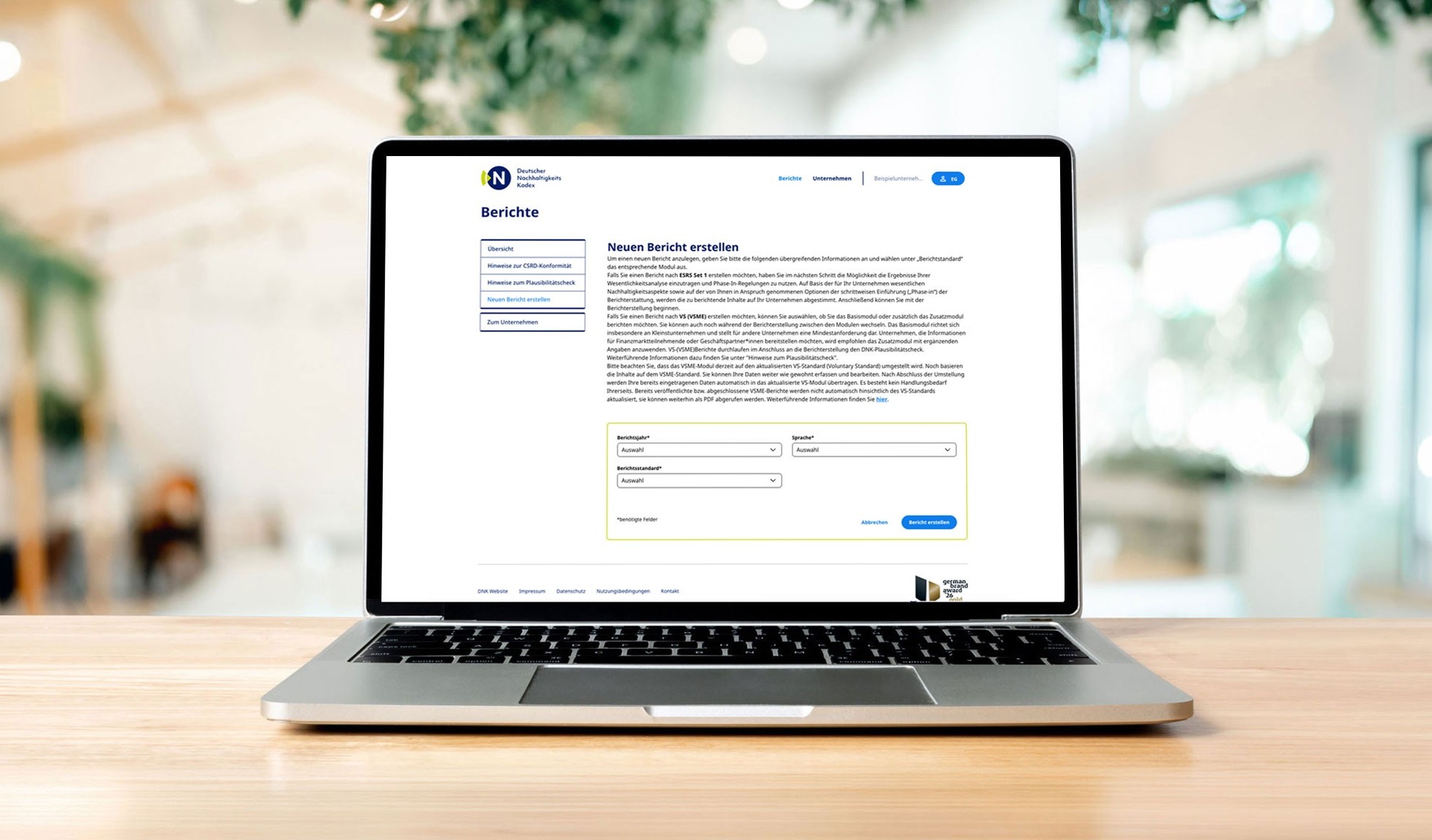
Click here to access the DNK platform, where you can create your report free of charge in accordance with CSRD and VSME requirements (currently only available in German).
Create CSRD/VSME-compliant reportYou can access the previous Sustainability Code Database here. It will be available to you until November 2026 for the creation of reports.
Create a Sustainability Code report
Use the DNK Platform to efficiently create your digital ESRS- or VSME-compliant report – free of charge.
Create your free reportAre you part of the supply chain of partner companies subject to mandatory reporting? Perhaps you need to provide sustainability information for financing? Or your customers simply expect transparency from you? Nowadays, even small and medium-sized enterprises are having to provide sustainability data to remain competitive – regardless of whether they are legally required to report. At the same time, the requirements are complex and often difficult to navigate.
This is where the German Sustainability Code (DNK) comes in, providing a practical solution for preparing sustainability reports. Funded by the German Federal Ministry for Economic Affairs and Energy (BMWE), the free DNK Platform guides you step by step through the entire process, making your work far easier. For more information see our fact sheet “The DNK at a glance”.
From trade and crafts businesses to industrial enterprises, more than 5,000 companies use the DNK platform to save time preparing their digital sustainability reports.
They particularly appreciate the following:
Six company representatives share how the DNK Platform helps them prepare their VSME-based sustainability reports. They highlight the main reporting challenges for small and medium-sized enterprises, the platform’s ease of use and the benefits it offers SMEs.
The DNK Platform provides a clear structure that walks you through the report with minimal extra effort, making sustainability reporting much more straightforward.
What does a completed sustainability report look like?
Here you’ll find examples of completed VSME-based reports that have already been published on the DNK Platform: View VSME reports.
Still not sure where to start?
Check out the media centre of our DNK Sustainability Campus. You’ll find video explainers, classifications of current topics, guides and publications such as “Five steps to your VSME report” or “The case for voluntary reporting at a glance”.
In a pilot process involving more than 20 industry associations and their member companies, VSME guidance was developed that takes the specific needs of each sector into account. The guidance and practical examples are directly integrated into the DNK Platform. Using the sector classification stored in the company profile (NACE codes), the platform automatically displays relevant information for each VSME data point.
VSME guidance for individual sectorsOur aim is to make the transition to the new platform as smooth as possible for everyone who has previously worked with the DNK database and prepared declarations under the old standard – whether they report voluntarily or are subject to mandatory reporting. You can still submit DNK declarations for 2025 in the existing DNK database until 30 November 2026.
The VSME-DNK gap analysis provides support for companies that have previously submitted DNK declarations and now wish to report under the VSME standard. On the new DNK platform, the company profile from the existing DNK database can be imported after initial registration. Get started!
Small and medium-sized enterprises in particular need solutions that are easy to understand, practical and ready to use. That’s precisely why we developed the DNK.
Victoria Diekkamp Reimann| Audit |
| Biodiversity analysis |
| Commonwealth |
| Conduct that complies with the law |
| Consistency |
| Corporate citizenship |
| Corruption |
| CR-Kompass |
| Diversity |
| Due diligence |
| Eco-efficiency analysis |
| Ecological footprint |
| Economy for the common good |
| Ecosystem services |
| EFFAS |
| EMAS |
| Employability |
| Employee engagement |
| Employees’ rights |
| Equal opportunities |
| EU Directive on Disclosure of Non-Financial Information |
| German Sustainable Development Strategy |
| Greenhouse Gas Protocol |
| GRI (Global Reporting Initiative) |
| Human rights |
| ILO (International Labour Organization) |
| Incentives |
| Innovations |
| ISO 14001 |
| ISO 26000 |
| ISO 50001 |
| ISO 9000 group of standards |
| Life cycle approach |
| Lobby lists |
| Management systems relating to aspects of sustainability |
| Materiality |
| Materiality analysis and materiality matrix |
| National Action Plan for Business and Human Rights |
| Objectives |
| Organisation for Economic Co-operation and Development (OECD) |
| Operationalising |
| Performance indicator |
| Policies |
| Political influence |
| Process |
| Product life cycle |
| Reliability |
| Resources |
| Resource efficiency |
| Risks |
| Rules and processes |
| SA 8000 |
| Scope of reporting |
| Stakeholders |
| Stakeholder dialogues |
| Standard |
| Supplier management systems |
| Supply chain |
| Sustainability aspects |
| Sustainability Code |
| Sustainability process |
| Sustainability strategy |
| Sustainable Balanced Scorecard (SBSC) |
| Sustainable Development Goals |
| Sustainable value |
| Task Force on Climate-related Financial Disclosures (TCFD) |
| UN Guiding Principles on Business and Human Rights |
| United Nations Global Compact (UNGC) |
| Value chain |
| VfU environmental performance indicators |